
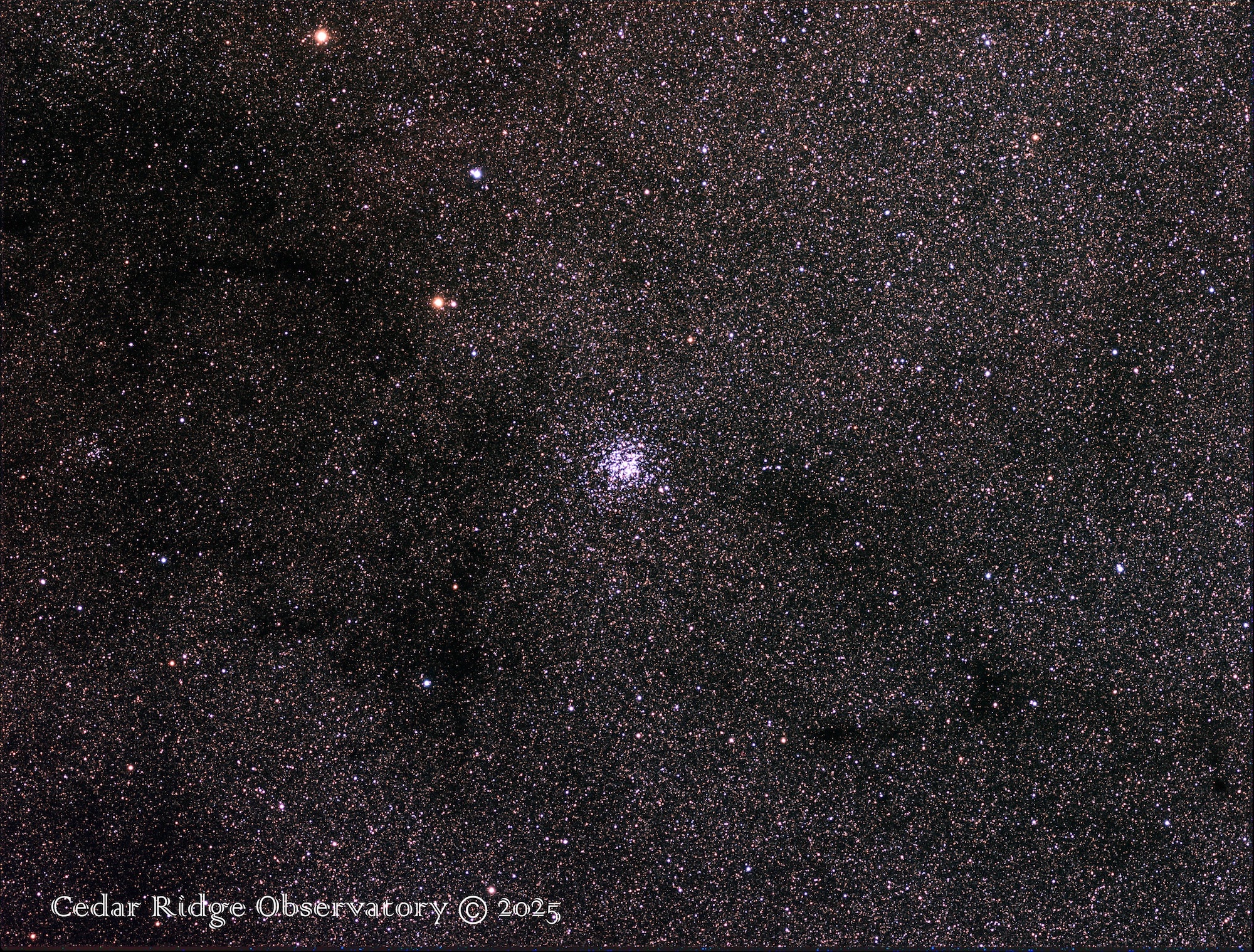
The Wild Duck Cluster, Messier 11, as captured by the WFAC (Askar 400 Astrograph). This HaLRGB image has a total integration time of 2.2 hours. Click on the image to view a larger version you can explore.
The Wild Duck Cluster: Messier 11 – A Stellar Jewel in Scutum
The Wild Duck Cluster, cataloged as Messier 11 (M11) or NGC 6705, ranks among the most impressive open star clusters in the night sky. Nestled in the faint constellation Scutum (the Shield), this dense gathering of stars lies about 6,200 light-years from Earth, making it the most distant Messier open cluster visible to the naked eye under dark conditions. Discovered by German astronomer Gottfried Kirch in 1681 and later added to Charles Messier’s famous catalog in 1764, its name comes from the V-shaped pattern of its brightest stars, which Admiral William Henry Smyth likened to a flock of flying wild ducks.
A Dense Stellar Swarm
M11 stands out for its exceptional richness and compactness. It contains an estimated 2,900 stars spread across a diameter of roughly 23–25 light-years, with a core densely packed at about 4 light-years across. This makes it one of the most massive and populous open clusters known, with a total mass ranging from 3,700 to 11,000 solar masses. The cluster’s age is approximately 220–316 million years—relatively young in cosmic terms—yet it already shows evolved stars, including yellow and red giants alongside hot, blue main-sequence members. Its high density creates a striking contrast: in the cluster’s center, stars are separated by less than a light-year on average, offering a dazzling view of stellar evolution in a crowded environment.
The above image capture M11’s brilliance: sparkling blue-white stars dominate the core, set against a rich Milky Way backdrop near the Scutum Star Cloud, with fainter members filling the field.
Observing the Wild Duck Cluster
With an apparent magnitude of 6.3, M11 appears as a hazy patch to the unaided eye in excellent skies but transforms dramatically through binoculars or a telescope. Small scopes reveal hundreds of sparkling stars, while larger apertures resolve thousands, highlighting the central V-shape and the prominent 8th-magnitude star near the middle. Best viewed from June to September when Scutum rises high in the south, it’s a summer favorite for northern hemisphere observers. Use the Summer Triangle (Altair, Vega, Deneb) as a guide: hop southwest from Altair toward 12 Aquilae to locate this gem.
Conclusion
M11 offers a window into the dynamic life of open clusters—born together, shining brightly, and destined to slowly disperse over hundreds of millions of years. For stargazers, it’s a reminder of the beauty hidden in the Milky Way’s star fields.
Image Info
- Imaged at Cedar Ridge, KY (Bortle 3)
- Camera : ZWO ASI1600MM Pro
- Scope: Askar 400 Quintuplet Astrograph f/5.6
- Mount: iOptron Smart-EQ Pro
- Luminance: 4 subframes of 300s = 20 min integration
- Red: 6 subframes of 300s = 30 min integration
- Green: 6 subframes of 300s = 30 min integration
- Blue: 6 subframes of 300s = 30 min integration
- Hydrogen Alpha: 4 subframes of 300s = 20 min integration
- Total integration time: 130 min = 2.2 hours.
- Captured via ASIAir Pro automation
- Optical tracking via ASIAir automation via the ASI120MM-S guide camera
- Separate channels stacked and LRGB integrated in Astro Pixel Processor
- Image run through Super DeNoising
- Final processing in Aperture