
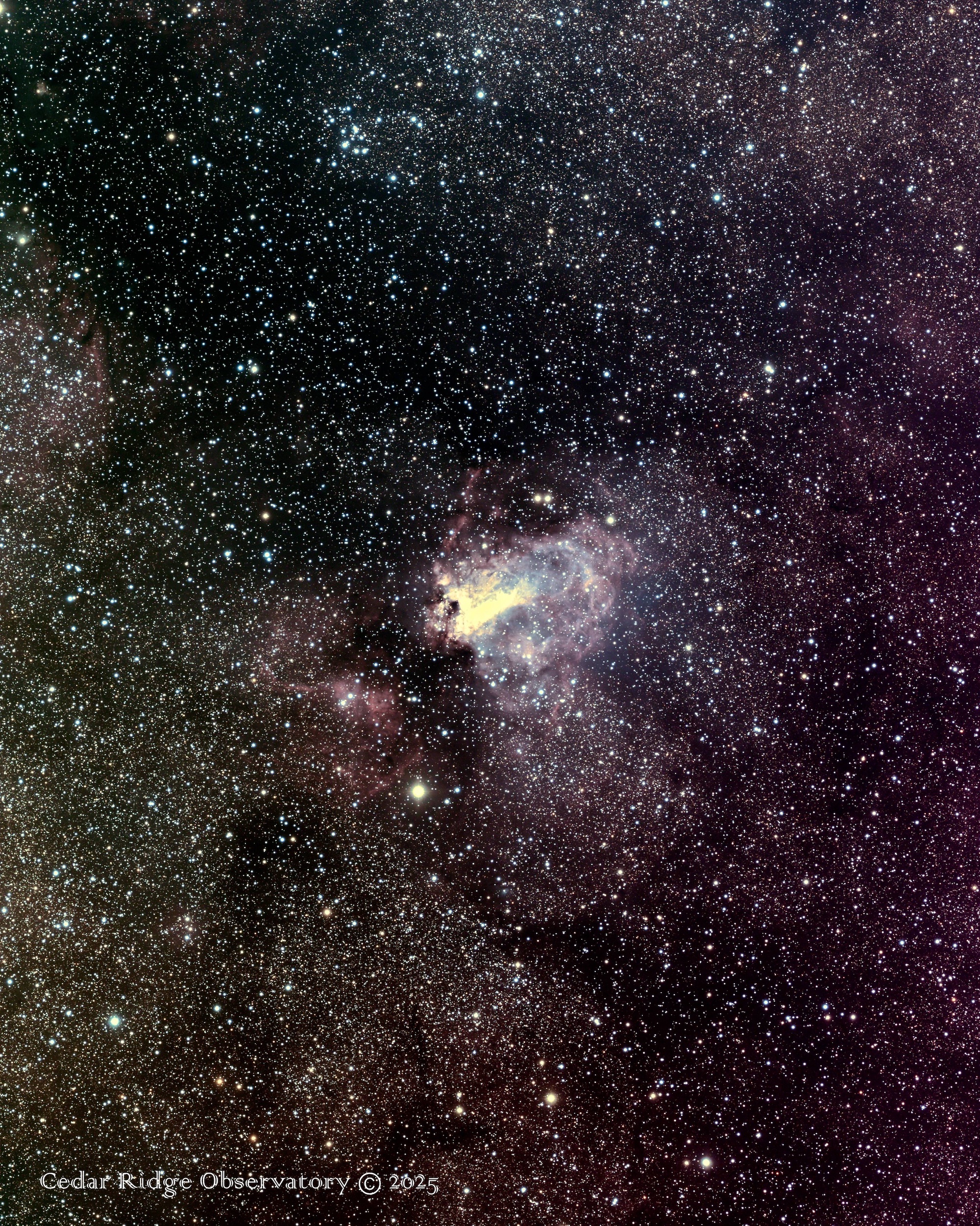
The Omega Nebula, Messier 17, as captured by the WFAC (Askar 400 Astrograph). This LRGB image has a total integration time of 9.75 hours. Click on the image to view a larger version you can explore.
The Omega Nebula: Messier 17 – A Glowing Stellar Nursery in Sagittarius
The Omega Nebula, also known as Messier 17 (M17), the Swan Nebula, Horseshoe Nebula, or Lobster Nebula, is one of the most striking emission nebulae in the night sky. Located in the constellation Sagittarius, this vibrant H II region shines with the light of ionized hydrogen gas excited by hot, young stars. Discovered by Swiss astronomer Jean-Philippe Loys de Chéseaux in 1745 and later cataloged by Charles Messier in 1764, M17 stands out for its bright, detailed structure and role as an active star-forming powerhouse.
Structure and Appearance
M17 appears as a glowing cloud with a distinctive shape resembling the Greek letter omega (Ω) or a swan, thanks to its bright central bar and curved extensions of gas and dust. The nebula spans about 15 light-years across, part of a larger molecular cloud roughly 40 light-years in diameter, with a total mass around 800 solar masses for the visible portion. Its reddish-pink hue comes from hydrogen-alpha emission, while dark dust lanes and pillars carve dramatic silhouettes. Embedded within is a young open cluster of about 35 hot O- and B-type stars, only around 1 million years old, whose intense ultraviolet radiation and stellar winds sculpt the surrounding gas, eroding dense clouds and triggering new star formation.
The image above reveals M17’s intricate beauty: vivid red and pink glowing regions contrast with dark dust features and sparkling foreground stars, showcasing the nebula’s dynamic environment in high detail.
Location and Observing Tips
Situated about 5,000–6,000 light-years away (estimates vary slightly), M17 lies in the rich star fields of the Sagittarius arm of the Milky Way. It has an apparent magnitude of around 6.0–7.0, making it visible in binoculars as a hazy patch and spectacular in small telescopes, where its swan-like form emerges. Best observed from June to September in the northern hemisphere, locate it using the Teapot asterism: start at Lambda Sagittarii (the lid) and move north past the Sagittarius Star Cloud (M24). It’s near other famous nebulae like the Lagoon (M8) and Trifid (M20), and shares the sky with the Eagle Nebula (M16).
M17 offers a captivating view of cosmic creation, where massive stars ignite and reshape their birthplace. For astrophotographers, narrowband filters highlight its glowing details, while visual observers enjoy its brightness amid the Milky Way’s glow—a true summer highlight.
Image Info
- Imaged at Cedar Ridge, KY (Bortle 3)
- Camera : ZWO ASI1600MM Pro
- Scope: Askar 400 Quintuplet Astrograph f/5.6
- Mount: iOptron CEM-26
- Luminance: 58 subframes of 300s = 290 min integration
- Red: 24 subframes of 300s = 120 min integration
- Green: 17 subframes of 300s = 85 min integration
- Blue: 18 subframes of 300s = 90 min integration
- Total integration time: 585 min = 9.75 hours.
- Captured via ASIAir Pro automation
- Optical tracking via ASIAir automation via the ASI120MM-S guide camera
- Separate channels stacked and LRGB integrated in Astro Pixel Processor
- Image run through Super DeNoising
- Final processing in Aperture