
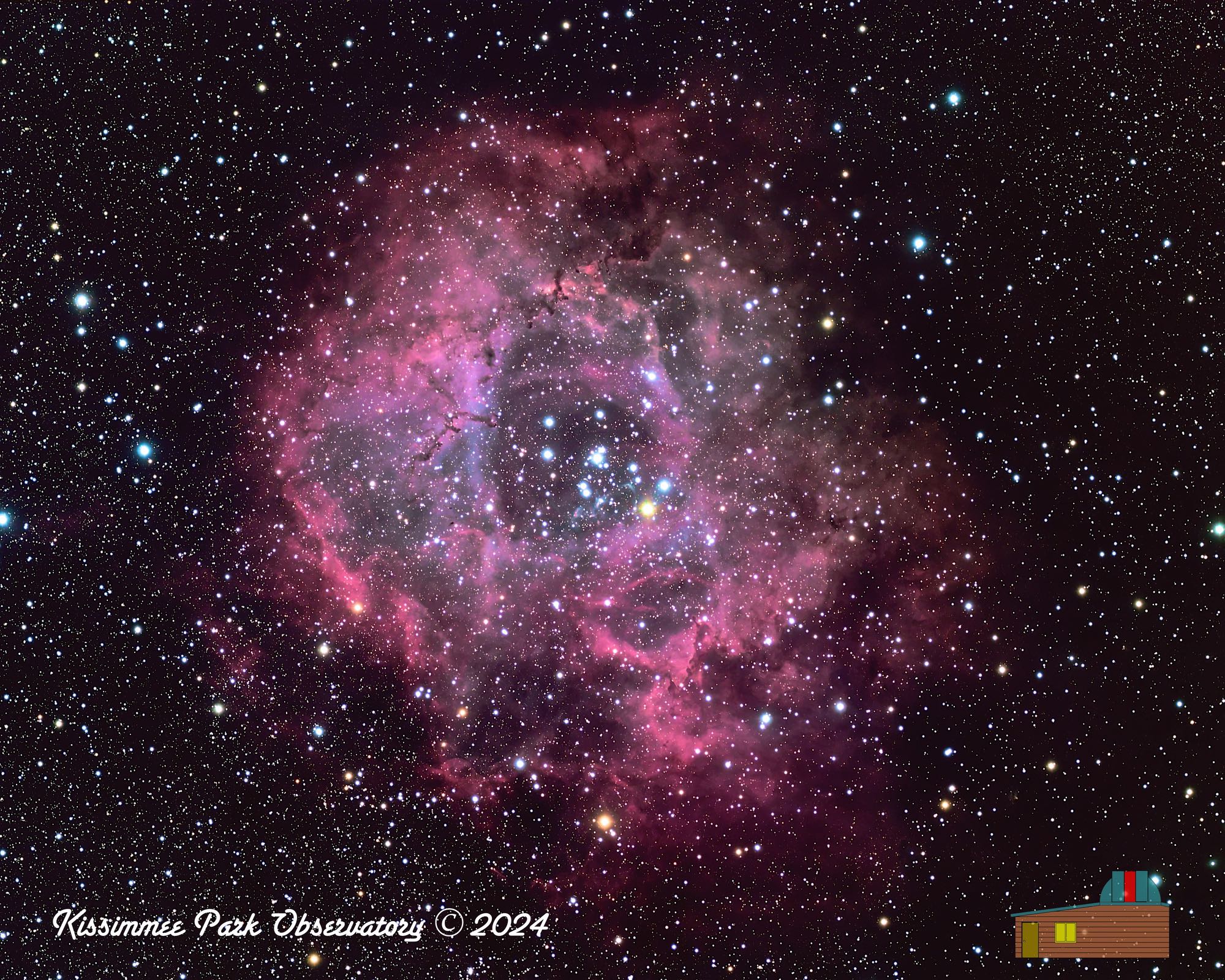
The Rosette Nebula, NGC 2244, as captured by the WFAC (Askar 400 Astrograph). This LRGB image has a total integration time of 5.8 hours. Click on the image to view a larger version you can explore.
The Rosette Nebula: A Winter Rose in Monoceros
The Rosette Nebula (Caldwell 49), comprising NGC 2237, 2238, 2239, and 2246, is one of the most stunning emission nebulae visible in the winter sky. This vast H II region encircles the young open star cluster NGC 2244 (Caldwell 50) in the constellation Monoceros, the Unicorn.
Location and Scale
Situated approximately 5,000–5,400 light-years away, the Rosette measures about 130 light-years across. In the sky, it spans 1–1.3 degrees—roughly twice the diameter of the full Moon—making it an excellent wide-field target for telescopes and cameras.
The Heart of the Nebula: NGC 2244
At the center is the open cluster NGC 2244, a group of hot, massive O- and B-type stars only 2–5 million years old. Their intense ultraviolet radiation ionizes the surrounding hydrogen gas, producing the bright red H-alpha emission that defines the nebula. Powerful stellar winds from these stars have blown a central cavity, creating the characteristic rose-petal or ring-like shape that gives the Rosette its name.
Astrophotography Highlights
The nebula lies within a larger molecular cloud complex in the Perseus Arm of the Milky Way, where star formation is still active. Narrowband images (especially the Hubble palette with H-alpha, OIII, and SII filters) showcase vivid crimson hydrogen emission, teal oxygen regions, and subtle sulfur highlights, accented by dark dust lanes, pillars, and globules that add dramatic contrast.
Observing Tips
Visually, the Rosette is subtle and best seen from dark skies (Bortle 4 or better). Binoculars or a small telescope may reveal the central cluster as a loose scattering of bright stars against a faint glow. A 4–8 inch scope under good conditions shows the central cavity and brighter arcs, especially with UHC or OIII filters. Patience and nebula filters help bring out the extended structure.
The nebula is highest in the southern sky during January and February evenings. From mid-northern latitudes (such as Columbia, Kentucky), look for it around 10 PM local time in mid-winter.
Why It Captivates
The Rosette Nebula beautifully illustrates the stellar lifecycle: massive young stars born from a cloud now sculpt and illuminate their birthplace while gradually dispersing it. Its blend of delicate beauty and cosmic power makes it a favorite for astrophotographers and a rewarding challenge for visual observers.
Image Info
The data for this image was captured in two separate locations and different times. The original luminance data was collected at Harper Texas, during a trip to view the total eclipse of April 2024. The great majority of the luminance and the color was taken at the Winter Star Party in the Florida Keys, in January 2025
Also see a previous narrowband image of the Rosette, taken at KPO.
- Imaged from Winter Star Party, Scout Key, FL (Bortle 4) and Harper, TX (Bortle 2)
- Camera : ZWO ASI1600MM Pro
- Scope: Askar 400 Quintuplet Astrograph f/5.6
- Mount: iOptron CEM-26 & iOptron SmartEQ Pro
- Luminance: 34 subframes of 300s = 170 min integration
- Red: 12 subframes of 300s = 60 min integration
- Green: 11 subframes of 300s = 55 min integration
- Blue: 12 subframes of 300s = 60 min integration
- Total integration time: 345 min = 5.75 hours.
- Captured via ASIAir Pro automation
- Optical tracking via ASIAir automation via the ASI120MM-S guide camera
- Separate channels stacked and LRGB integrated in Astro Pixel Processor
- Image run through Super DeNoising
- Final processing in Aperture