
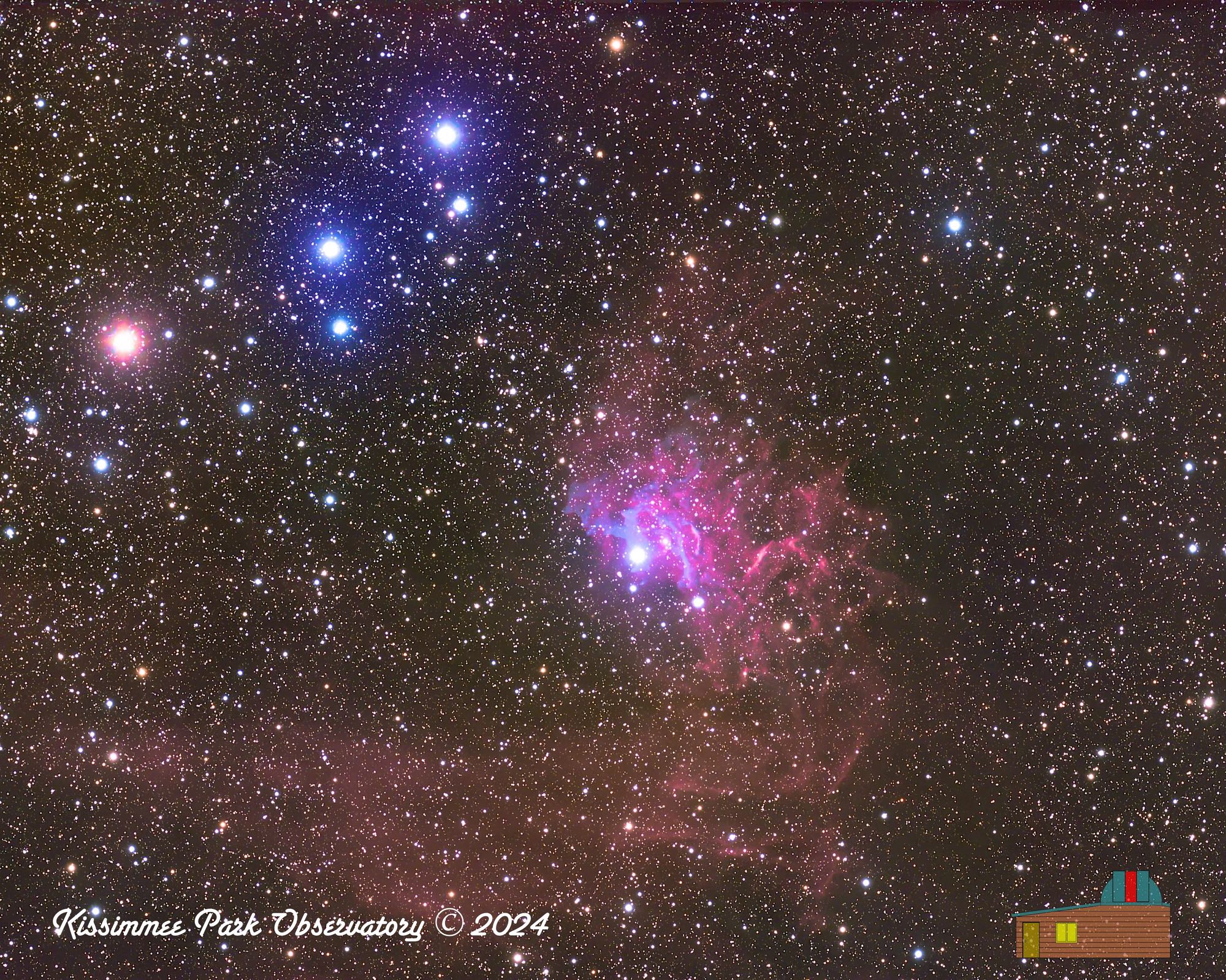
The Flaming Star Nebula, IC 405, as captured by the WFAC (Askar 400 Astrograph). This LRGB image has a total integration time of 7.5 hours. Click on the image to view a larger version you can explore.
The Flaming Star Nebula (IC 405): A Cosmic Flame in Auriga
The Flaming Star Nebula (IC 405, also SH 2-229 or Caldwell 31) is a striking emission/reflection nebula in the constellation Auriga. Its glowing red hydrogen clouds and delicate blue reflection dust create a dramatic, flame-like appearance.
Key Facts
- Distance: ~1,500 light-years
- Size: ~5 light-years across (apparent size ~37′ × 19′)
- Brightness: Apparent magnitude ~6.0 — visible in small telescopes under dark skies
- Location: Near IC 410, M36, and M38 in Auriga
The Power Source: AE Aurigae
The nebula is illuminated by AE Aurigae, a hot, massive O9.5V star with surface temperatures exceeding 30,000 K. This runaway star was ejected from the Trapezium cluster in Orion long ago and is now plowing through a molecular cloud, ionizing hydrogen (producing red H-alpha glow) and scattering light off dust (creating blue reflection areas).
Visual Appearance
Photographs show rippling dark dust lanes against vivid red emission, accented by soft blue reflection veils. The mix of emission and reflection makes IC 405 one of the most colorful nebulae for amateur astrophotographers. Narrowband imaging (Hα, OIII, SII) reveals even finer details.
How to Observe It
From northern latitudes like Kentucky, Auriga is well-placed on winter evenings. A 4–8 inch telescope under Bortle 4 or darker skies shows the brighter core and the brilliant blue-white AE Aurigae. Nebula filters (UHC or OIII) and averted vision help reveal more of the faint glow.
Summary
IC 405 tells a story of cosmic motion: a high-speed runaway star sculpting beauty far from its birthplace. It’s a vivid reminder of the dynamic processes that shape our galaxy.
Image Info
The data for this image was captured in two separate locations and different times. The original luminance data was collected at Harper Texas, during a trip to view the total eclipse of April 2024. The great majority of the luminance and the color was taken at the Winter Star Party in the Florida Keys, in January 2025
- Imaged from Winter Star Party, Scout Key, FL (Bortle 4) and Harper, TX (Bortle 2)
- Camera : ZWO ASI1600MM Pro
- Scope: Askar 400 Quintuplet Astrograph f/5.6
- Mount: iOptron CEM-26 & iOptron Smart-EQ Pro
- Luminance: 26 subframes of 300s = 130 min integration
- Red: 22 subframes of 300s = 110 min integration
- Green: 24 subframes of 300s = 120 min integration
- Blue: 21 subframes of 300s = 105 min integration
- Total integration time: 465 min = 7.75 hours.
- Captured via ASIAir Pro automation
- Optical tracking via ASIAir automation via the ASI120MM-S guide camera
- Separate channels stacked and LRGB integrated in Astro Pixel Processor
- Image run through Super DeNoising
- Final processing in Aperture