
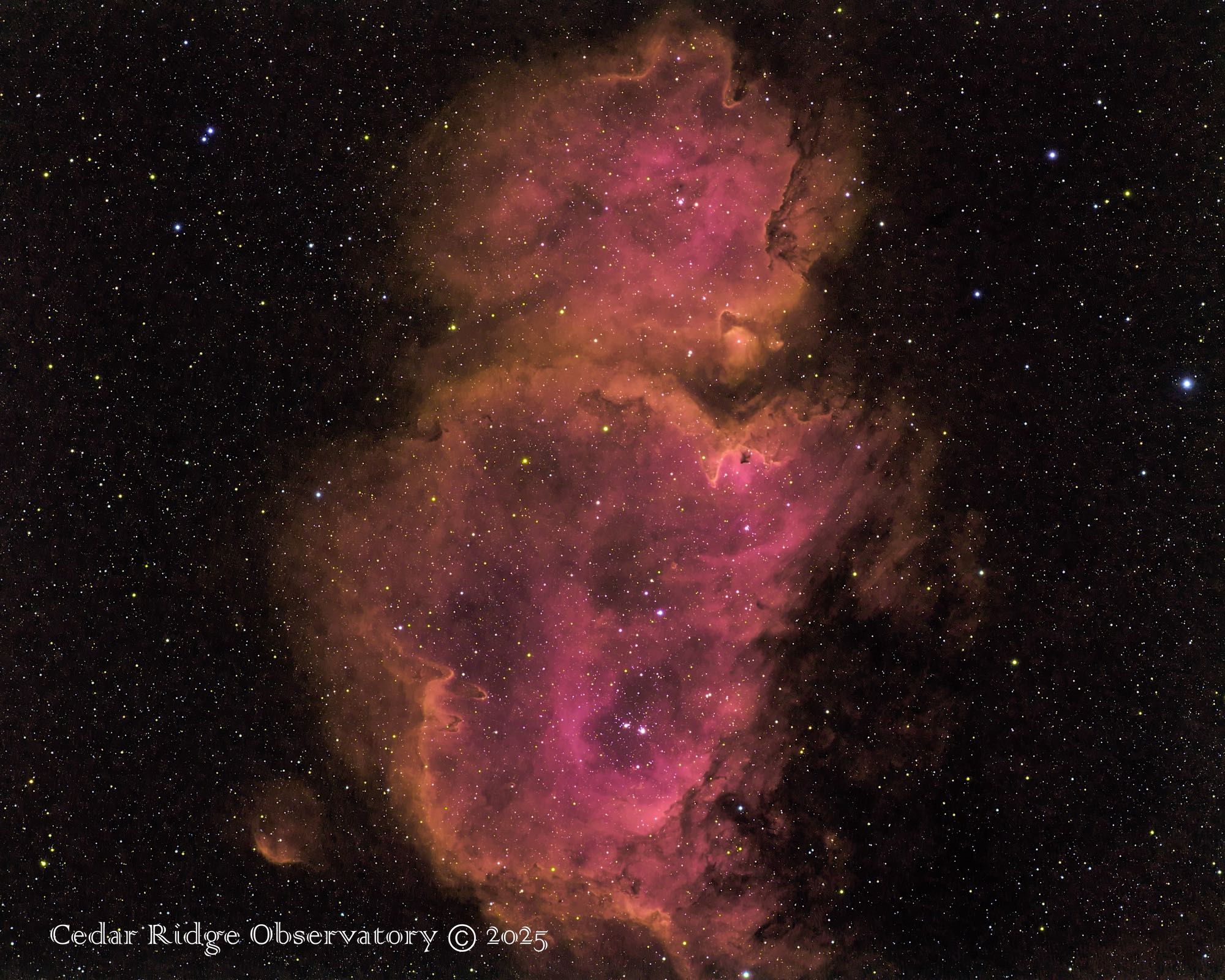
The Soul Nebula, IC 1848, as captured by the WFAC (Askar 400 Astrograph). This HSO image has a total integration time of 14.8 hours. Click on the image to view a larger version you can explore.
The Soul Nebula: IC 1848 – A Cosmic Cradle of Stars
The Soul Nebula, also known as IC 1848, Westerhout 5 (W5), or Sharpless 2-199, is a breathtaking emission nebula in the constellation Cassiopeia. Often paired with its famous neighbor, the Heart Nebula (IC 1805), the duo forms the iconic “Heart and Soul” complex—a vibrant region of active star formation in the Perseus Arm of our Milky Way galaxy. This glowing cloud of ionized gas and dust lies approximately 6,500 to 7,500 light-years from Earth and spans about 100–150 light-years across, making it a stunning target for astrophotographers.
The Beauty and Structure of the Soul Nebula
IC 1848 earned its evocative name from its resemblance to a human soul or embryo in wide-field views, with a distinctive “head” and “body” shape sculpted by powerful stellar winds. The nebula glows brightly in hydrogen-alpha emission, appearing in vivid reds and pinks due to excited hydrogen gas. Embedded within are several young open star clusters, including the one officially designated IC 1848 (Collinder 32), along with others like Collinder 33 and 34 in the “head” region. These hot, massive O- and B-type stars, only about 1 million years old, illuminate the nebula and carve out cavities with their intense ultraviolet radiation and stellar winds. Dense pillars of gas and dust—some spanning 10 light-years—point toward the central clusters, protecting nascent stars forming at their tips in a process reminiscent of the famous “Pillars of Creation” in the Eagle Nebula.
The attached images showcase the nebula’s intricate details: glowing red hydrogen regions, dark dust lanes, and bright star clusters that highlight ongoing star birth.
Observing and Photographing the Soul Nebula
From dark skies, the Soul Nebula is challenging for visual observers but rewards telescopes with filters, revealing its hazy glow and embedded stars. It shines at an apparent magnitude around 6.5, best viewed from July to April when Cassiopeia rides high in the northern sky. Astrophotographers capture its full splendor using narrowband filters (Ha, OIII, SII) to emphasize the ionized gases, often combining it with broadband data for natural colors. Long exposures reveal subtle details like evacuated bubbles and the bridge of material linking it to the Heart Nebula.
Conclusion
The Soul Nebula stands as a dynamic reminder of the universe’s ongoing creation, where massive stars ignite, sculpt, and fuel new generations in this stellar nursery.
Image Info
A previous version of the Soul Nebula was taken at KPO in Central Florida in 2021. This shot of the Soul has over twice the exposure, and was taken under pristine Bortle 3 skies of Kentucky.
- Imaged at Cedar Ridge, KY (Bortle 3)
- Camera : ZWO ASI1600MM Pro
- Scope: Askar 400 Astrograph
- Mount: iOptron Smart-EQ Pro
- Hydrogen Alpha: 60 subframes of 300s = 300 min integration
- Oxygen III: 58 subframes of 300s = 290 min integration
- Sulfur: 60 subframes of 300s = 300 min integration
- Total integration time: 320min = 14.8 hours.
- Captured via ASIAir Pro automation
- Optical tracking via ASIAir automation via the ASI120MM-S guide camera
- Separate channels stacked and HSO integrated in Astro Pixel Processor
- Image run through Super DeNoising
- Final processing in Aperture