
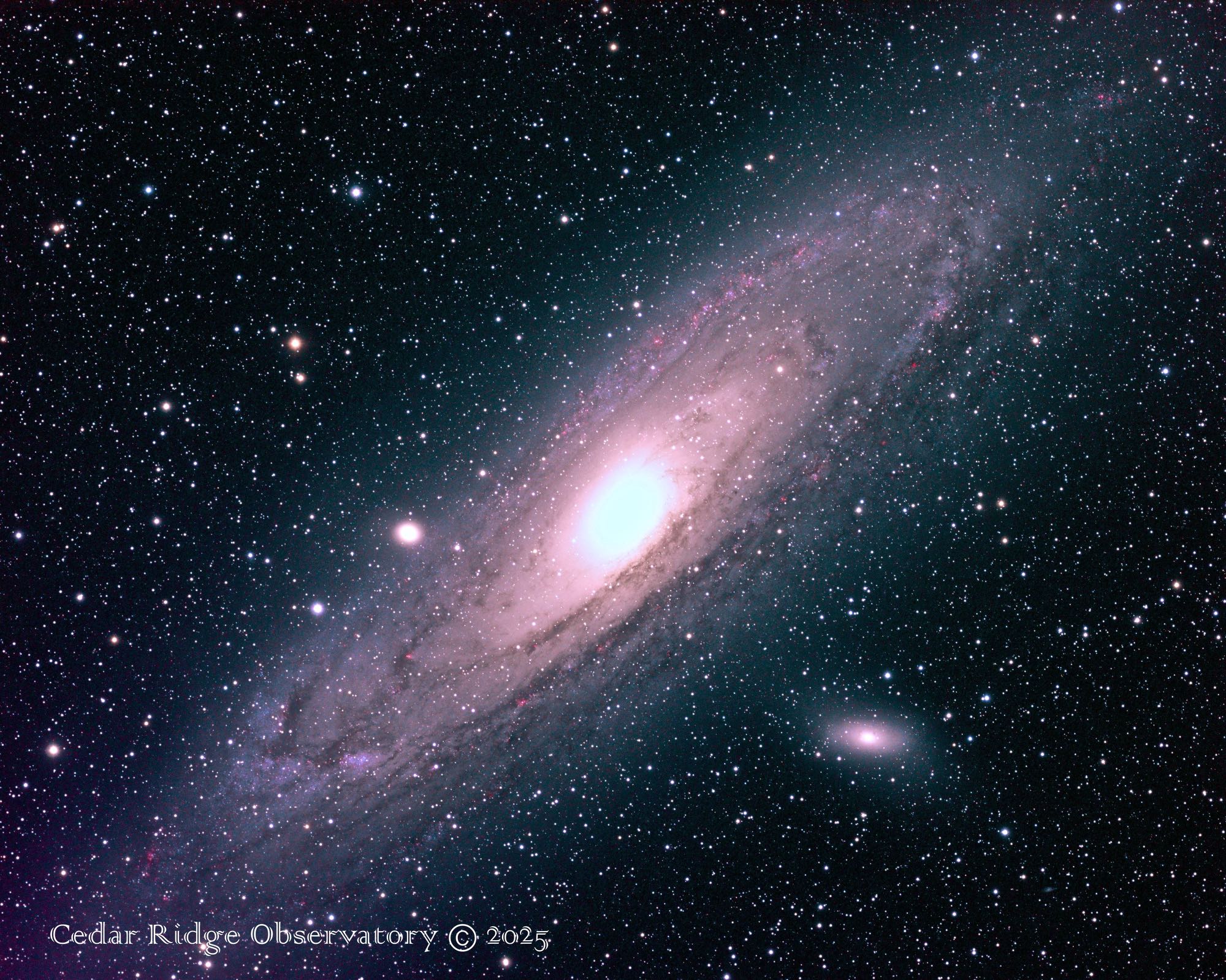
The Andromeda Galaxy, Messier 31, as captured by the WFAC (Askar 400 Astrograph). This LRGB image has a total integration time of 8.5 hours. Click on the image to view a larger version you can explore.
The Andromeda Galaxy: Our Cosmic Neighbor, Messier 31
The Andromeda Galaxy, cataloged as Messier 31 (or M31), is one of the most awe-inspiring objects in the night sky. As the closest major spiral galaxy to our Milky Way, it offers a breathtaking preview of galactic structure and our shared cosmic future. Located about 2.5 million light-years away in the constellation Andromeda, M31 is the farthest object visible to the naked eye under dark skies, appearing as a faint smudge larger than the full moon.
What Makes Andromeda Special?
Andromeda is a barred spiral galaxy spanning roughly 220,000 light-years—larger than the Milky Way—with an estimated 1 trillion stars, vast dust lanes, and active star-forming regions. Its bright central bulge, packed with older stars, contrasts with sweeping spiral arms glowing blue from young, hot stars and pinkish hydrogen clouds. Recent observations, including a massive 2025 Hubble Space Telescope mosaic assembled from over 600 images, reveal intricate details like dense star fields, companion galaxies, and subtle ring structures.
The above image, captured by Cedar Ridge Observatory in 2025, beautifully captures this grandeur: the galaxy’s tilted disk displays prominent dust lanes threading through luminous arms, with a radiant core at the center. Faint satellites like M32 and M110 appear as nearby smudges, emphasizing Andromeda’s place in the Local Group.
A Future Galactic Merger
One of the most fascinating facts about Andromeda is its impending collision with the Milky Way. In about 4–5 billion years, the two galaxies will merge in a slow, graceful dance, forming a new elliptical galaxy. Stars are so widely spaced that direct collisions will be rare, but gravitational interactions will reshape both systems dramatically.
Observing Andromeda Today
For backyard astronomers, M31 is a prime target. Binoculars reveal its core and hazy extent, while telescopes show spiral arms and companions. Long-exposure astrophotography, like the stunning Cedar Ridge image, unveils details invisible to the eye—dusty lanes, star clusters, and subtle colors from ionized gas.
Andromeda reminds us of the universe’s vast scale and interconnectedness. As our nearest large galactic neighbor, it bridges the observable and the profound, inviting wonder at the dynamic cosmos we inhabit.
Image Info
Also see a previous image of the Andromeda Galaxy, taken at KPO. The difference between this newest shot over the previous shows the advantages of a dark sky over a light-polluted sky.
- Imaged at Cedar Ridge, KY (Bortle 3)
- Camera : ZWO ASI1600MM Pro
- Scope: Askar 400 Quintuplet Astrograph f/5.6
- Mount: iOptron CEM-26
- Luminance: 35 subframes of 300s = 175 min integration
- Red: 16 subframes of 300s = 80 min integration
- Green: 17 subframes of 300s = 85 min integration
- Blue: 15 subframes of 300s = 75 min integration
- Hydrogen Alpha: 18 subframes of 300s = 90 min integration
- Total integration time: 505 min = 8.5 hours.
- Captured via ASIAir Pro automation
- Optical tracking via ASIAir automation via the ASI120MM-S guide camera
- Separate channels stacked and LRGB integrated in Astro Pixel Processor
- Image run through Super DeNoising
- Final processing in Aperture