
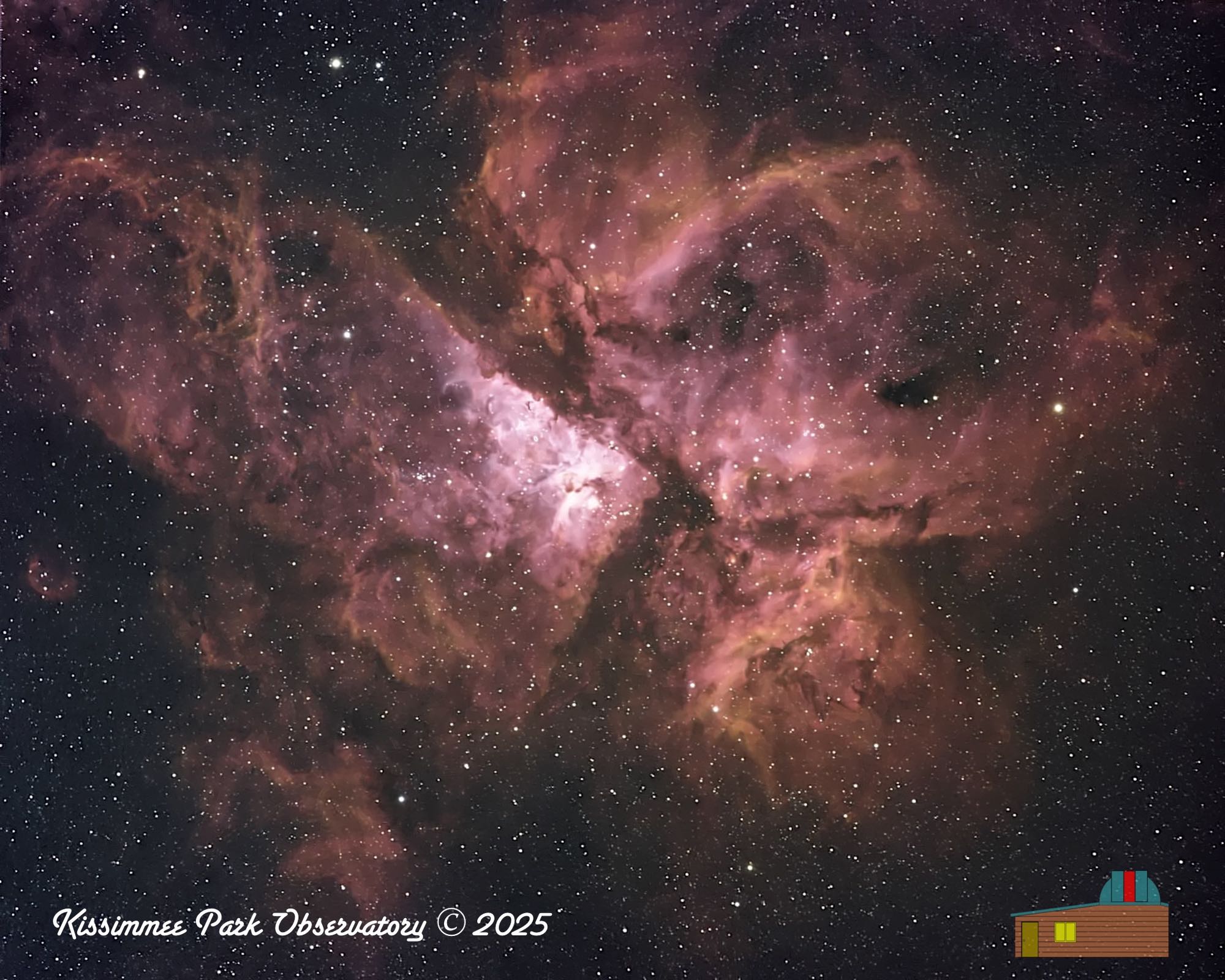
The Rosette Nebula, NGC 2244, as captured by the WFAC (Askar 400 Astrograph). This HSO image has a total integration time of 4.1 hours. Click on the image to view a larger version you can explore.
The Eta Carinae Nebula (NGC 3372): A Southern Celestial Wonderland
The Eta Carinae Nebula, also known as NGC 3372 or the Great Carina Nebula, is one of the largest and most spectacular emission nebulae in the Milky Way. This vast region of glowing gas and dust, centered on the hyper-luminous star system Eta Carinae, lies in the southern constellation Carina and ranks among the most dramatic star-forming complexes visible from Earth.
Location and Scale
The nebula is located approximately 7,500 light-years away (estimates range from 6,500–8,500 ly), placing it in the Carina–Sagittarius Arm of our galaxy. It spans an enormous 200–260 light-years across—several times larger than the Orion Nebula—making its apparent size in the sky about 2–3 degrees, roughly 4–6 times the width of the full Moon. This immense scale makes it a stunning wide-field object.
The Central Powerhouse: Eta Carinae
Dominating the nebula is Eta Carinae, a luminous blue variable (LBV) system containing at least two massive stars. The primary is one of the most luminous and unstable stars known, with a combined luminosity exceeding 5 million times that of the Sun. In the 1840s, Eta Carinae underwent the “Great Eruption,” briefly becoming the second-brightest star in the sky and ejecting material that formed the famous Homunculus Nebula around it. Today, it’s still highly variable and expected to explode as a supernova or hypernova in the (astronomical) near future.
The intense ultraviolet radiation and powerful stellar winds from Eta Carinae and other massive O- and B-type stars ionize the surrounding hydrogen, producing the nebula’s brilliant red H-alpha glow while carving out cavities and sculpting intricate pillars and “cosmic cliffs.”
Astrophotography Highlights
Images reveal a chaotic yet beautiful landscape: crimson emission nebulae, dark dust lanes, bright rims, and structures like the Keyhole Nebula (a prominent dark patch near Eta Carinae). Narrowband processing (H-alpha, OIII, SII) emphasizes glowing gas details, while Hubble and JWST views showcase fine pillars of creation, young star clusters, and ongoing star birth amid dense molecular clouds.
Observing Tips
NGC 3372 is a southern-sky gem, best seen from latitudes south of about +30°N. From Columbia, Kentucky (around 37°N), it barely rises above the southern horizon during late winter/early spring (February–April), appearing low and affected by atmospheric haze—making it tough without a clear southern view. Farther south (e.g., Florida or international dark sites), binoculars reveal the bright central glow and Eta Carinae as a standout star, while a 4–8 inch telescope under dark skies shows extended nebulosity, the Keyhole, and surrounding clusters.
Use UHC or OIII filters to enhance contrast against light-polluted skies.
Why It Captivates
The Eta Carinae Nebula showcases extreme stellar evolution and star formation on a grand scale. Home to some of the universe’s most massive stars, it offers a glimpse into violent cosmic processes that shape galaxies—while reminding us of the transient nature of even the brightest stellar phenomena.
A true southern treasure, NGC 3372 rewards observers willing to travel or wait for perfect conditions.
Image Info
The data for this image was captured at the Winter Star Party in the Florida Keys, in January 2025. This is an HSO image; Red is mapped to Hydrogen Alpha, Green is mapped to Sulphur II, and Blue is mapped to Oxygen III. We were blessed with very clear skies on the southern horizon, which made this image possible; this nebula culminates at only 5 degrees above the ocean at the WSP.
- Imaged from Winter Star Party, Scout Key, FL (Bortle 4)
- Camera : ZWO ASI1600MM Pro
- Scope: Askar 400 Quintuplet Astrograph f/5.6
- Mount: iOptron CEM-26
- Hydrogen Alpha: 29 subframes of 300s = 127 min integration
- Oxygen III: 21 subframes of 300s = 87 min integration
- Sulphur II: 16 subframes of 300s = 32 min integration
- Total integration time: 246 min = 4.1 hours.
- Captured via ASIAir Pro automation
- Optical tracking via ASIAir automation via the ASI120MM-S guide camera
- Separate channels stacked and LRGB integrated in Astro Pixel Processor
- Image run through Super DeNoising
- Final processing in Aperture