
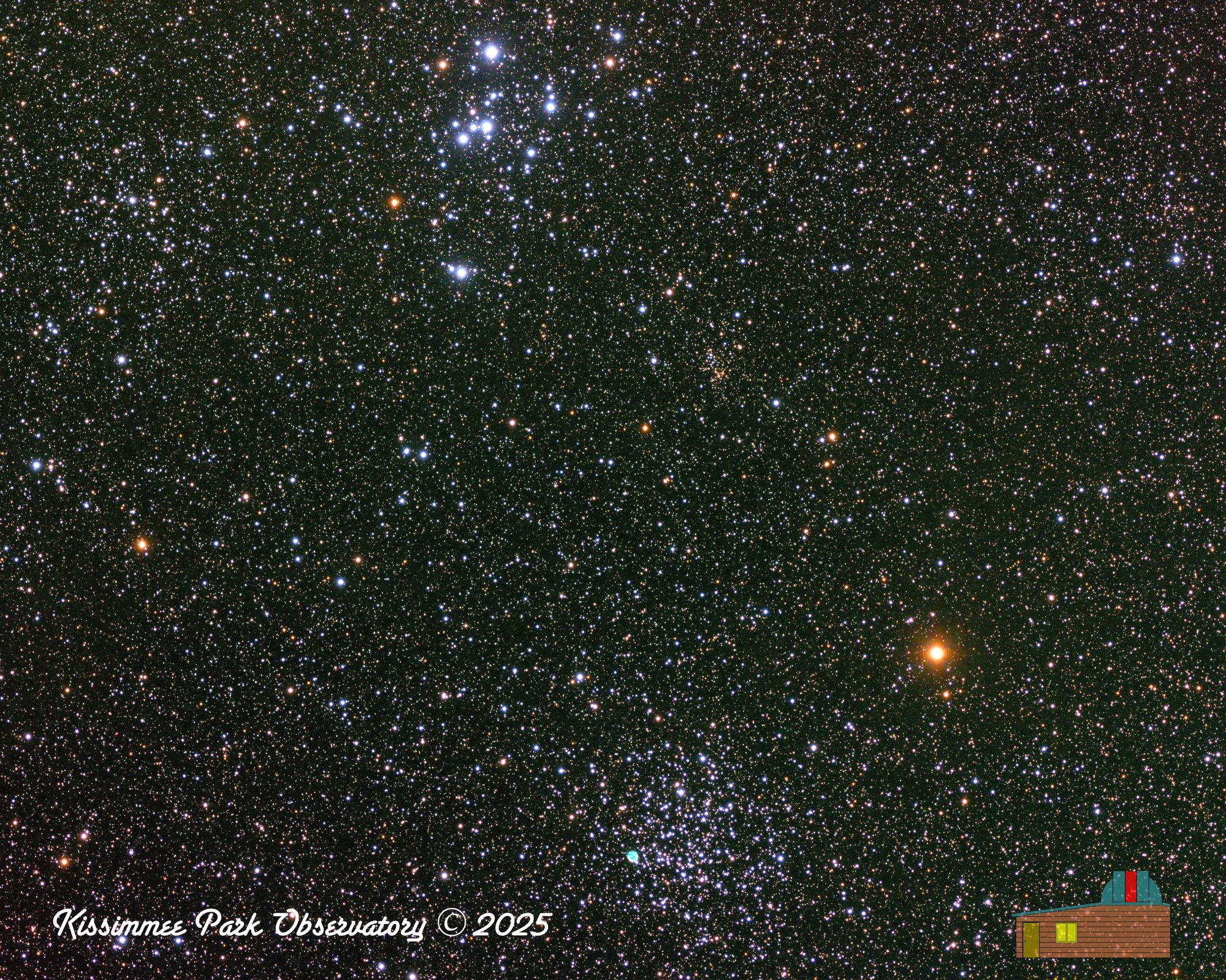
The Open Clusters M46 (lower) and M47 (upper), in the constellation of Canis Major, as captured by the WFAC (Askar 400 Astrograph). This RGB image has a total integration time of 1.5 hours. Click on the image to view a larger version you can explore.
Messier 46 and Messier 47: Twin Open Clusters in Puppis
Messier 46 (NGC 2437) and Messier 47 (NGC 2422) are two contrasting open star clusters in the constellation Puppis, the Stern. Lying less than 1.5° apart in a rich Milky Way field, they form a superb pair for winter observers in the southern sky. Both were cataloged by Charles Messier in the 18th century, offering a beautiful study in similarities and differences.
Location and Accessibility
Both clusters reside in Puppis, a southern constellation best viewed from latitudes south of about +40°N. From Columbia, Kentucky (around 37°N), they rise moderately high in late winter and early spring (February–April), appearing in the southeast after dark. Use bright Sirius in Canis Major as a guide—hop southeastward to find this sparkling region.
Messier 47: The Bright and Youthful Cluster
M47 is the brighter and more conspicuous of the pair, with an apparent magnitude of about 4.4—visible to the naked eye under dark skies as a hazy patch. It lies roughly 1,600 light-years away and spans about 12–14 light-years in true diameter (appearing ~30’ across in the sky).
The cluster contains around 50–120 visible stars, dominated by bright, hot blue-white giants. Estimated at just 78 million years old, M47 is relatively young, giving it a loose, scattered appearance with striking brighter members that make it rewarding in binoculars or small telescopes.
Messier 46: The Richer, Distant Gem
M46 appears fainter at magnitude 6.1 but is far richer, containing an estimated 500 stars across a true diameter of about 26–30 light-years (apparent size ~25–30’). It lies much farther away, at approximately 5,400–5,500 light-years, which dims its overall brightness despite the higher star count.
At around 220–300 million years old, M46 is older and more compact, showing a denser concentration of fainter stars. Its standout feature is the planetary nebula NGC 2438, a beautiful ring of glowing gas superimposed near the cluster’s northern edge (though foreground/background—unrelated to the cluster itself). This adds extra intrigue for astrophotographers.
Visual and Photographic Appeal
In binoculars or a small telescope, M47 pops as a bright, loose grouping of sparkling stars. M46 requires darker skies or a 4–8 inch scope to appreciate its richness and the subtle glow of NGC 2438 (best with an OIII filter). Wide-field views capture both clusters together, set against the Milky Way’s glow, with M47’s brighter stars contrasting M46’s misty density.
Astrophotographers love this duo for their proximity and variety—combine short exposures for the bright M47 stars with longer ones to reveal M46’s fainter members and the planetary nebula’s delicate shells.
Why They Captivate
M46 and M47 highlight the diversity of open clusters: one nearby and youthful, the other distant and mature. Together, they showcase star formation across different epochs and distances in our galaxy’s disk.
A rewarding pair for any clear winter night—grab your scope and enjoy this Messier double feature!
Image Info
The data for this image was captured at the Winter Star Party in the Florida Keys, in January 2025. Star clusters are easy to capture in RGB (no luminance) with a very short exposure on the respective color channels.
- Imaged from Winter Star Party, Scout Key, FL (Bortle 4)
- Camera : ZWO ASI1600MM Pro
- Scope: Askar 400 Quintuplet Astrograph f/5.6
- Mount: iOptron CEM-26
- Red: 15 subframes of 300s = 30 min integration
- Green: 14 subframes of 300s = 28 min integration
- Blue: 15 subframes of 300s = 30 min integration
- Total integration time: 88 min = 1.5 hours.
- Captured via ASIAir Pro automation
- Optical tracking via ASIAir automation via the ASI120MM-S guide camera
- Separate channels stacked and LRGB integrated in Astro Pixel Processor
- Image run through Super DeNoising
- Final processing in Aperture