
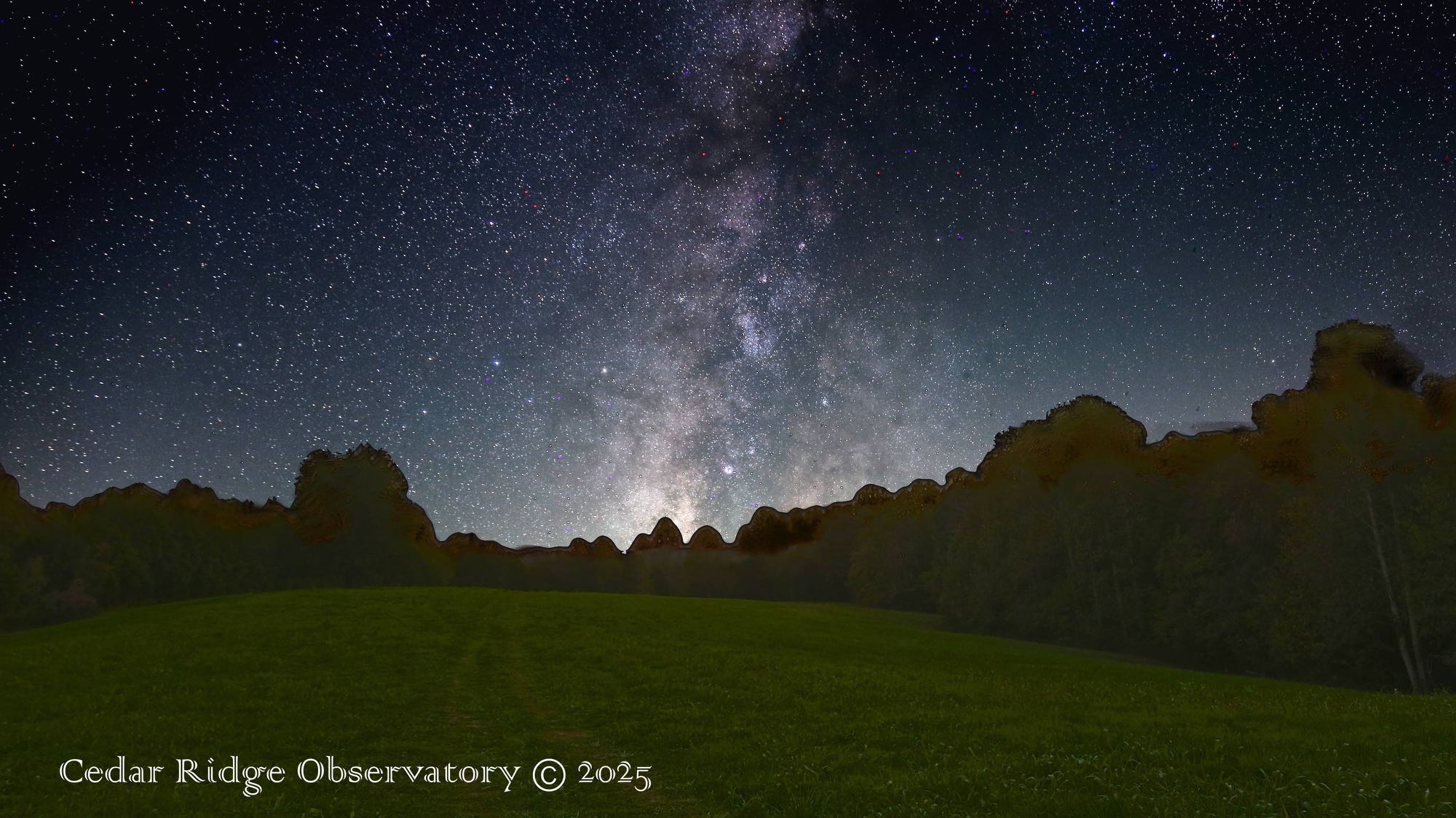
The Milky Way over South Field of Cedar Ridge in Kentucky. This image has a total integration time of 2.5 hours. Click on the image to view a larger version you can explore.
Milky Way over Cedar Ridge
The photograph captures a breathtaking, wide-angle view of the night sky above South Field at Cedar Ridge in Kentucky, taken as a 2.5-hour integrated exposure (a tracked, stacked composite of multiple sub-exposures to reduce noise and bring out faint details while keeping stars pin-sharp).
Foreground Landscape
The lower third of the image shows a gently rolling, open grassy South Field—lush and vividly green even under starlight—stretching from the foreground up to a subtle ridgeline. A faint dirt path or mowed trail cuts diagonally across the grass, adding a sense of gentle human presence and scale. The field appears to slope downward slightly toward the camera, creating an immersive, foreground-to-horizon composition.
Rising immediately behind the field is a dark, silhouetted tree line or forested ridge. The trees form an irregular, rugged horizon with prominent, jagged outlines with several taller, rounded canopy shapes. These dark forms create a dramatic, almost gothic silhouette against the bright sky, framing the galactic core like natural battlements. The woods appear dense and deciduous, consistent with central/eastern Kentucky’s mixed hardwood forests.
Sky and Milky Way
The dominant feature is an extraordinarily detailed and luminous Milky Way arching nearly overhead to high in the frame. The galactic plane runs diagonally from roughly lower-left to upper-right, with the brightest, densest portion (the galactic core in Sagittarius/Scorpius) positioned prominently near the center-top.
- Core region: Intensely bright, showing a golden-white/yellowish glow with strong magenta/purple hints from hydrogen emission nebulae (especially around the Lagoon and Trifid areas). Dark lanes of interstellar dust are clearly visible as black rivers cutting through the glow, creating the classic “rift” appearance.
- Overall band: The Milky Way widens and brightens toward the core, then tapers and dims toward the edges. Numerous faint star clouds and unresolved star fields give it a textured, cloudy look.
- Star field: Thousands of pinpoint stars fill the sky from horizon to zenith. The density is highest along the galactic plane, gradually thinning out toward the darker upper-left and lower-right corners. Bright individual stars stand out sharply—several magnitude 1–2 stars (likely including Antares low near the horizon, Vega high up, Altair, Deneb, and others forming parts of the Summer Triangle).
- Color and contrast: The sky transitions from deep navy/black at the zenith/edges to warmer tones near the horizon due to atmospheric extinction and possibly faint airglow or residual twilight influence. Subtle green airglow banding may be present in places, though the dominant color is the natural bluish-white of stars overlaid on the Milky Way’s creamy/yellow-white core.
Technical and Aesthetic Notes
This long-integration image reveals far more detail than the eye could see unaided—even in excellent dark-sky conditions—thanks to stacking and noise reduction. The result is an almost three-dimensional depth: the foreground feels grounded and earthy, while the sky appears vast and infinite. The composition uses the classic “landscape + galactic core” astro-landscape formula very effectively, with the silhouetted ridge acting as a perfect natural frame that doesn’t overpower the sky.
Overall, it’s a stunning example of modern astrophotography: crisp, richly detailed, emotionally evocative, and a powerful reminder of how dark rural Kentucky skies can still reveal the grandeur of our galaxy.
Image Info
- Imaged from Cedar Ridge, KY (Bortle 3)
- Camera : Canon 6D
- Lens: Canon 24-105mm L @ f\5.6
- Mount: iOptron SkyGuider Pro
- Sky Raw frames: 75 subframes of 120s = 150 min integration
- Total integration time: 150 min = 2.5 hours.
- Landscape frame: 24mm, 1/320 sec.
- Subframes stacked in Astro Pixel Processor
- Landscape and Sky images layered in PhotoShop
- Image run through Super DeNoising
- Final processing in Aperture