
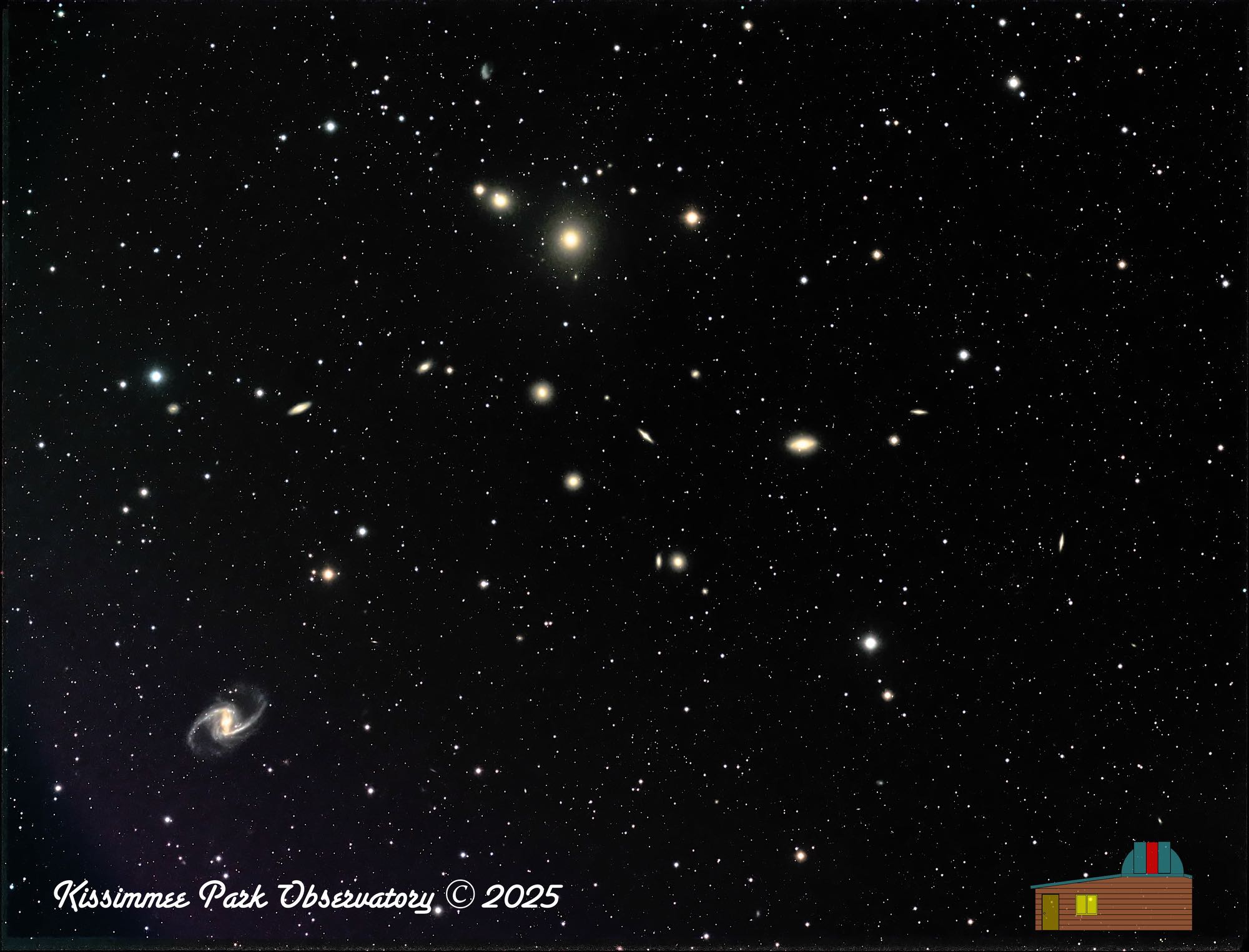
The Fornax Galaxy Cluster, as captured by the WFAC (Askar 400 Astrograph). This LRGB image has a total integration time of 4.4 hours. Click on the image to view a larger version you can explore.
Exploring the Fornax Galaxy Cluster: A Southern Deep-Sky Treasure
The Fornax Galaxy Cluster (Abell S0373) is one of the closest rich galaxy clusters to our Milky Way and a breathtaking target for southern-hemisphere astronomy enthusiasts. Packed with hundreds of galaxies, it offers a fascinating glimpse into how gravity shapes galaxies over cosmic time.
Location and Scale
Located in the faint constellation Fornax (the Furnace), the cluster sits about 62 million light-years away (roughly 19 megaparsecs). It covers several million light-years in true extent and contains several hundred member galaxies, making it a moderately rich cluster with a total mass dominated by dark matter and hot intracluster gas.
Dominant Members
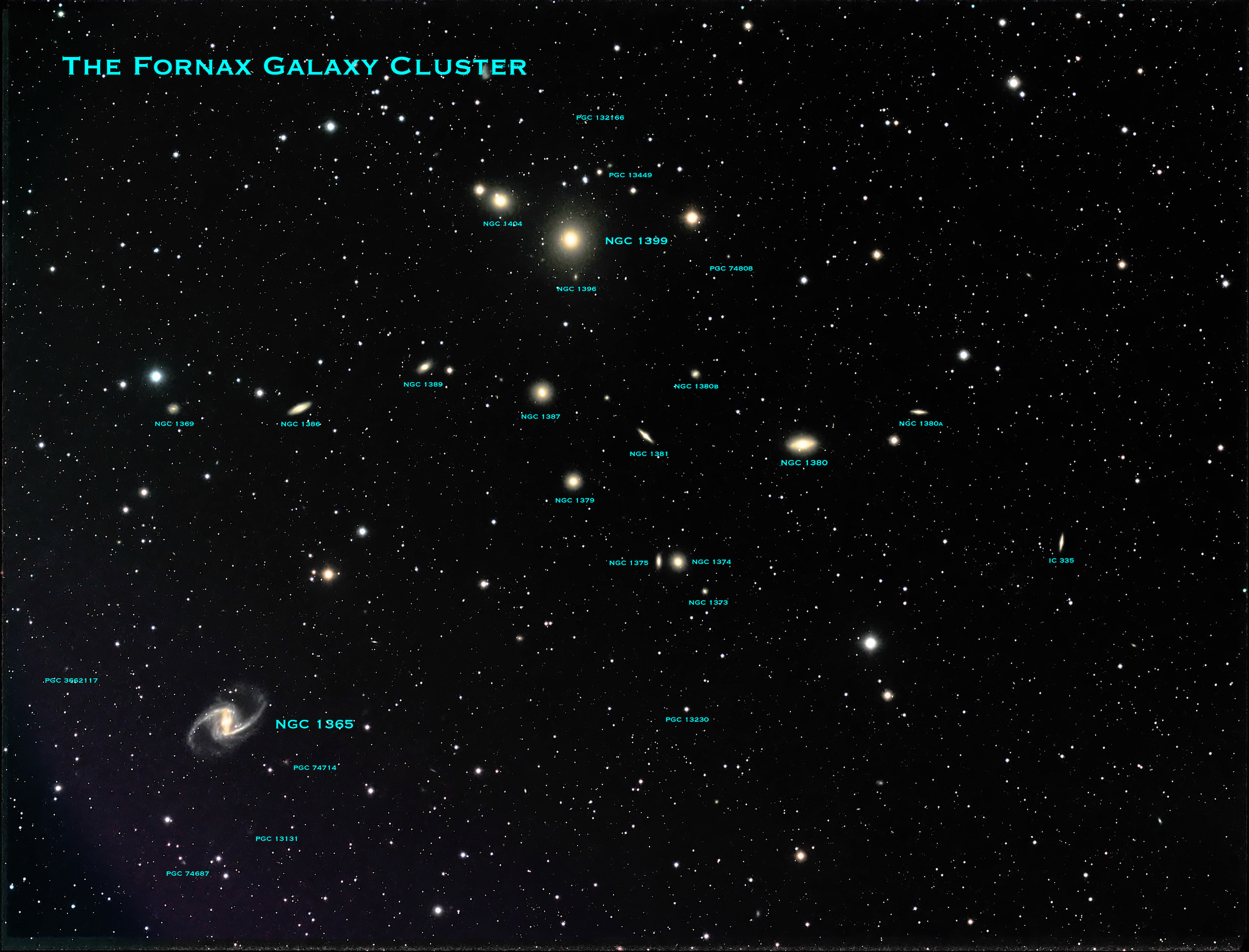
The gravitational heart of the cluster is NGC 1399, a giant cD elliptical galaxy that anchors the core and hosts thousands of globular clusters. Nearby lies NGC 1404, another luminous elliptical showing signs of tidal interaction and gas stripping. Among the most striking members is NGC 1365, a beautiful face-on barred spiral with prominent dust lanes and active star formation. The cluster is rich in early-type galaxies (ellipticals and lenticulars), a signature of dense environments where galaxy mergers and ram-pressure stripping have transformed spirals into smoother shapes. See an annotated version of the image to explore the members.
Astrophotography and Scientific Appeal
Wide-field images capture dozens of galaxies scattered across the frame, with bright ellipticals contrasting against fainter spirals and dwarfs. Deep exposures reveal faint intracluster light, tidal debris, and ultra-diffuse galaxies. The Fornax Cluster serves as an important laboratory for studying galaxy evolution, dynamical friction, harassment, and the formation of central dominant galaxies like NGC 1399.
Observing Tips
Being a southern object, Fornax is best viewed from latitudes south of +30°N. From the mid US, the cluster barely clears the southern horizon during winter (November–February), reaching only 15–20° altitude around midnight in December–January. Low elevation means significant atmospheric dimming and potential light pollution or horizon obstructions—clear southern views are essential.
Under excellent dark southern skies (Florida, Texas, or farther south), binoculars can show NGC 1399 and NGC 1404 as faint fuzzies near a 7th-magnitude star. A 4–8 inch telescope under Bortle 4 or better conditions reveals the core ellipticals clearly, while larger apertures bring out NGC 1365’s barred structure and additional cluster members.
Why It Captivates
The Fornax Cluster demonstrates how crowded cosmic neighborhoods accelerate galaxy evolution—stripping gas from infalling spirals and building massive ellipticals at the center. As one of our nearest rich clusters, it bridges the gap between the local Virgo Cluster and more distant superclusters, offering a vivid snapshot of galactic history.
For southern observers or those willing to chase clear southern horizons, the Fornax Galaxy Cluster delivers a rewarding deep-sky experience filled with galactic variety and cosmic drama.
Image Info
The data for this image was captured at the Winter Star Party in the Florida Keys, in January 2025. See an annotated version that identifies all the separate members of the galaxy cluster.
- Imaged from Winter Star Party, Scout Key, FL (Bortle 4)
- Camera : ZWO ASI1600MM Pro
- Scope: Askar 400 Quintuplet Astrograph f/5.6
- Mount: iOptron CEM-26
- Luminance: 17 subframes of 300s = 85 min integration
- Red: 12 subframes of 300s = 60 min integration
- Green: 12 subframes of 300s = 60 min integration
- Blue: 12 subframes of 300s = 60 min integration
- Total integration time: 265 min = 4.4 hours.
- Captured via ASIAir Pro automation
- Optical tracking via ASIAir automation via the ASI120MM-S guide camera
- Separate channels stacked and LRGB integrated in Astro Pixel Processor
- Image run through Super DeNoising
- Final processing in Aperture